

Introduction
MotoGP is more than just the top motorcycle racing competition in the world; it’s a world where riders create heroes by pushing themselves and their bikes far beyond what most people can conceive, where bravery meets peril, and where accuracy meets chaos. Every racing weekend is like a dramatic movie, full of unexpected plots, poignant triumphs, devastating wrecks, and unadulterated human tenacity.
Riders can sprint from zero to 100 km/h in less than three seconds, lean their motorcycles at previously unthinkable angles, and battle for every moment as if their entire existence depended on it. This sport is at the very limit of human capabilities. Millions of people worldwide have been enthralled by MotoGP’s spectacle, which combines violent speed, deft technique, and extreme pressure.
Both the engineers who relentlessly develop technology that redefines the future of motorcycle racing and the riders who risk their lives are driven by ambition and fanaticism in the world of MotoGP. To gain fractions of a second, teams devote endless hours to data analysis, aerodynamics adjustments, electronics refinement, and power delivery optimization. Beneath the glitzy exterior of race day is a world of sacrifice, restless nights, lengthy travel times, injuries, recovery, and ongoing adjustment to new rules and advancements.
Riders have to strike a balance between boldness and fear, aggression and accuracy, reflexes and strategy. Whether they succeed as heroes or fail as victims of the harsh nature of the sport depends on every choice they make on the track, from braking points to overtaking attempts.
The relationship between supporters and the riders they support is what gives MotoGP its emotional impact. Famous athletes like Valentino Rossi, Marc Márquez, Casey Stoner, Jorge Lorenzo, and many more have shaped entire generations’ passion for motorsports throughout the sport’s history. In the world of sports culture, their conflicts, rivalries, triumphs, and injuries have become classic tales. Even now, a new generation of riders is emerging, sparking new rivalries and altering the competitive environment. Fans are kept engaged in this fast-paced environment by the sound of roaring engines, the blur of colorful racing outfits, and the thrilling last-lap confrontations.
The Exciting Development of MotoGP Racing
Since its founding, MotoGP has seen a significant transformation, moving from untamed, unpredictable road races to a sophisticated, dangerously exciting competition that displays the best human skill and motorcycle tech. Riders competed on improvised tracks in the early decades, frequently traveling on public highways encircled by little more than hay bales.
These early races laid the groundwork for a sport based on speed, boldness, and unrelenting innovation, despite the enormous hazards involved. As time went on, technology developed, safety increased, and the sport shifted to specially designed circuits that enabled riders and machines to compete at previously unheard-of levels. With the advent of four-stroke engines, electronic control systems, and aerodynamics, MotoGP entered a new age in which power-control balance was crucial.
The increased rivalry between manufacturers is another indication of MotoGP’s development. With innovations in engine performance, electronic stability, and lightweight materials, Yamaha, Honda, Ducati, and subsequently KTM and Aprilia revolutionized racing.
Teams must continuously develop since every season offers new advancements in seamless gearboxes, traction control, and aerodynamics. Riders must change with the machines as engineers push the envelope, adapting their riding techniques to handle more power, more precise braking, and sophisticated electronic systems. Because of this human-machine interaction, MotoGP is now a test of adaptation and comprehension of intricate racing technologies in addition to speed.
The way fans engage with MotoGP is as crucial to the sport’s development. Millions of fans now follow riders’ personal adventures, training, rivalries, and emotional struggles thanks to international broadcasts, behind-the-scenes films, and social media access. Fans are now strongly connected to the culture of the sport through immersive MotoGP weekends. Every season seems more fierce than the last, from thrilling final-lap fights to surprising championship turns. One of the most thrilling sports ever developed, MotoGP has developed into a whole ecosystem of technology, entertainment, athleticism, and international community.
The Riders: The Track’s Fearless Warriors
MotoGP riders are warriors molded by peril, discipline, and an obsession with speed; they are not your typical athletes. With only a leather suit to protect them, riders push themselves to the edge at speeds beyond 350 km/h in every race, requiring a degree of bravery that most people would never encounter in their lifetime. As they brake hard, lean aggressively, and battle for positions in races where even the smallest hesitation might cost them victory, their bodies undergo cruel forces.
Every rider has made sacrifices throughout their lives, beginning in their early years when they trained on little bikes, participated in junior competitions, and honed the mental toughness needed to endure in this harsh sport.Because racing is in their blood, they return to the track despite living in constant danger and being aware that injuries are frequent and recuperation is frequently difficult.
The ability of MotoGP riders to precisely operate huge machines while controlling excitement, fear, and split-second decision-making is what makes them so remarkable. In order to maintain control of a bike that can easily overpower opponents, a rider must analyze the track, anticipate their actions, and rapidly modify their racing path. Years of training have honed their reflexes, but their emotional fortitude is equally remarkable.
Many riders demonstrate their commitment to the sport by competing despite severe physical suffering, fractured bones, and injuries. Knowing that every race might have an impact on their career, relationships with teammates, and personal legacy, they work under extreme pressure.
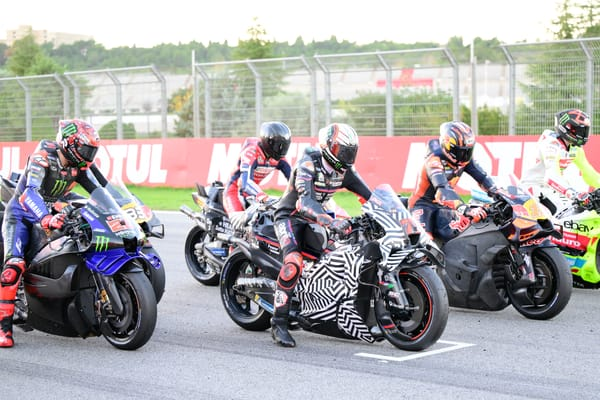
Millions of fans are inspired by MotoGP riders’ tenacity, humility, and battling spirit, which transcends their helmets and leathers. Their tales of triumphs, heartbreaks, rivalries, comebacks, and setbacks extend beyond the track. Through their fierce rivalry and iconic performances, legends like Valentino Rossi, Marc Márquez, Jorge Lorenzo, and Casey Stoner have influenced the sport.
The current generation of riders carries on the tradition by infusing the championship with new rivalry and intensity. These fighters embody the spirit of MotoGP, demonstrating that genuine excellence stems from ardor, tenacity, and the guts to confront peril head-on.
Inside the Machines: MotoGP Bikes’ Engineering
MotoGP bikes are engineering marvels, the result of years of testing, invention, and unrelenting speed-seeking. The sole goal of these motorcycles’ construction is to accelerate as quickly as possible while maintaining control in the most demanding racing environments. In contrast to road motorcycles, which prioritize comfort, safety, and longevity, MotoGP machines are precision weapons built to produce world-class braking performance, explosive acceleration, and razor-sharp handling.
The bikes weigh less than a lightweight commuter motorcycle, despite their engines producing enormous power—often more than 250 horsepower. Both the machines and the riders are pushed to their physical and mental limits by this combination of great power and low weight. From the engine to the suspension, every part is constructed from cutting-edge materials like titanium, carbon fiber, and aerospace-grade alloys, all of which are designed to enhance strength while conserving weight.
The advanced electrical technology incorporated into every facet of performance is what really sets MotoGP bikes apart from other racing vehicles. Electronic control technologies like wheelie control, traction control, engine braking management, and data telemetry have a significant impact on modern MotoGP.
Through bends, acceleration zones, and high-speed straights, these systems enable riders to maintain stability and control while controlling the engine’s overwhelming power. However, engineers must continuously adjust the settings to meet a rider’s particular style, track conditions, and tire behavior because electronics alone cannot win races.
Every lap during a race weekend gives fresh data that engineers evaluate in real time, modifying throttle response, suspension stiffness, fuel mapping, and aerodynamics to achieve the ideal setup. The foundation of MotoGP team strategy is this ongoing loop of knowledge and modification, which makes engineering an essential component of winning races.
One of the most significant advancements in MotoGP engineering is aerodynamics. Modern bikes have airflow channels, streamlined fairings, and complex winglets to help stabilize the bike at high speeds. By reducing wheelies, increasing downforce, and improving turning grip, these aerodynamic designs enable riders to brake more forcefully and accelerate sooner.
Manufacturers are competing fiercely to achieve the best possible balance between speed and stability as a result of the development of aerodynamics. MotoGP has entered a new phase when engineering prowess is just as vital as rider competence as a result of this technological struggle. MotoGP is a genuinely amazing sport, with each race serving as a demonstration of state-of-the-art technology in action, thanks to the balance of human talent and technical innovation.
MotoGP athletes’ training, physical condition, and mental toughness
MotoGP riders are among the world’s strongest, fittest, and most mentally tough athletes, despite the fact that their athleticism is frequently underrated. Because every lap exposes a rider to extreme g-forces, strong vibrations, and continuous strain on every muscle in the body, riding a MotoGP machine at full speed requires exceptional physical training.
In addition to having to withstand the strain of bending at sharp angles while maintaining the bike’s stability with extraordinary leg and arm strength, riders must possess extraordinary core strength to stay stable under intense braking, where the force can surpass 1.5 g.
Every race lasts between forty and forty-five minutes, during which time cyclists battle exhaustion every second and burn hundreds of calories. Weightlifting, cycling, running, swimming, and high-intensity exercises intended to increase cardiovascular endurance and enhance reaction speed are common components of their training regimens. Their bodies develop into precisely calibrated instruments that can survive the harsh rigors of competitive racing.
However, physical fitness is just one aspect of the situation. To live in a sport where pressure, risk, and dread coexist every weekend, MotoGP riders must develop mental toughness. They work in a setting where a single error could lead to an injury or the loss of a championship lead, and this ongoing reality necessitates a mindset based on self-control and discipline. Through focus exercises, visualization, meditation, and learning to maintain composure under pressure, riders develop their mental skills. They have to shut out distractions and go into a mental state where their instincts guide them before every race.
One of the key reasons some riders succeed while others struggle is their capacity to maintain composure in the face of last-lap clashes, unforeseen weather conditions, or intense overtaking attempts. The unseen muscle that keeps them competitive long after their bodies are worn out is mental resilience.
Few sportsmen in the world can equal the tremendous physical and mental endurance that MotoGP riders possess. They push themselves well beyond what is typically expected of humans, endure suffering, and recover from wounds. Their training focuses on improving balance, responsiveness, endurance, and a mindset that can face danger head-on rather than just increasing strength or speed. MotoGP racers are developed into brave performers who can withstand the intensity of racing at speeds above 300 km/h thanks to this special combination of physical and mental training.
MotoGP is one of the most challenging and breathtaking sports on the planet because of their commitment and discipline.
The Strategy: How Teams Organize, Forecast, and Carry Out Victories
Although MotoGP may appear to be a race solely focused on speed and bravery, every victory is actually the result of a world of strategy that takes place at the team headquarters and garages. Long before the riders take their places on the grid, the preparation for a race starts. To develop a strategy that optimizes the capabilities of both the rider and the machine, engineers examine track layouts, historical data, weather forecasts, tire performance, and fuel usage.
Depending on how the bike is set up, the team must determine how hard the rider can push through each corner, straight, and braking zone.
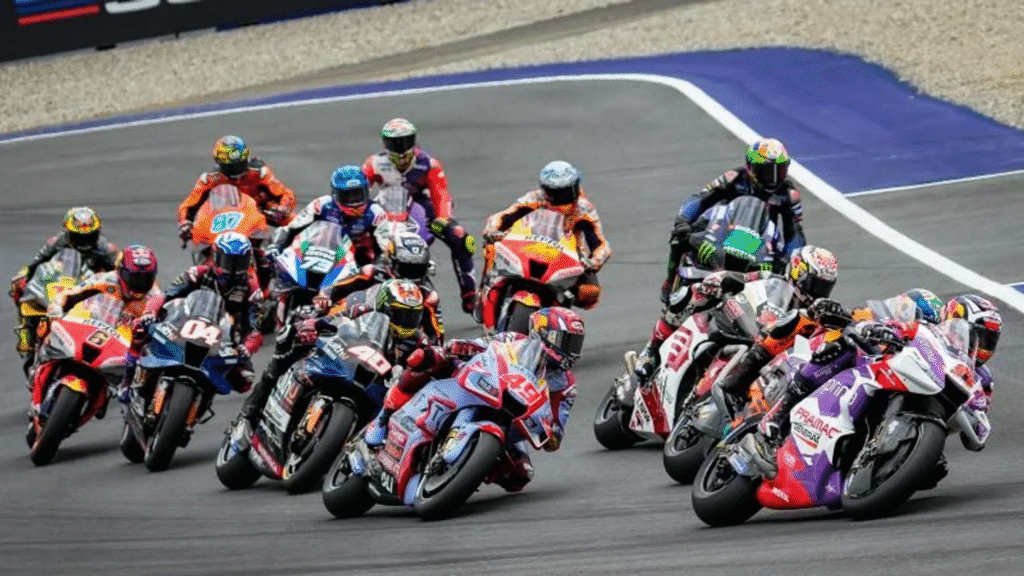
A race’s result can be altered by making even the tiniest changes to the traction control setting, aerodynamic angle, or suspension stiffness. Because strategy frequently makes the difference between finishing on the podium and fading into the midfield in MotoGP, this invisible layer of preparation is what turns a quick rider into a possible winner.
With each lap on race day, strategy keeps changing. MotoGP teams are able to track tire wear, temperature, fuel mapping, and electronic settings by continuously monitoring real-time data from the bike’s sensors. In order to stay focused and resist the urge to attack too soon, riders must swiftly adjust to these shifting circumstances.
In contemporary MotoGP, controlling tire life has emerged as one of the most important strategic components. If a rider pushes too hard in the beginning, they may achieve early places, but later on, their tires may deteriorate, leaving them susceptible in the last laps.
However, in the last seconds of the race, a cyclist who conserves their tires early might reach their maximum speed. The weather also has a significant impact, particularly when it starts to rain in the middle of the race, forcing competitors to switch bikes at the pits and drastically altering the order of the race.
A key component of an effective racing plan is the communication between the team and the rider. Throughout the race, riders rely on dashboards, pre-arranged signals, and instinct to modify their strategy. They have to choose between attacking, defending, and exercising patience. For the engineers, forecasting the race’s course is like trying to solve a puzzle that is always changing.
They have to predict the strategies of competitors, assess variations in speed, and determine the ideal time for their rider to attack. In MotoGP, strategy is always changing, breathing, and responding to every turn of the wheel. It transforms raw speed into clever racing and shapes some of the most memorable moments in MotoGP history. It is the invisible backbone of the sport.
Legendary Moments and the Drama of MotoGP Rivalries
Rivalries, the intense and passionate conflicts that take place not only on the track but also in the hearts of millions of spectators, have always been what define MotoGP. Every race is made unpredictable by these rivalries, which also add levels of drama, passion, and tension that take the sport beyond simple rivalry. While some rivalries arise from disagreements over personality, riding style, or contentious situations, others are developed out of respect.
Unforgettable showdowns—moments where two riders pushed each other to the limit, testing not only their speed but also their bravery, patience, and mental toughness—are common in MotoGP history. These conflicts have molded MotoGP’s character, transforming routine races into iconic moments in the history of motorsport. They also show the emotional side of racing, where, at speeds exceeding 300 km/h, pride, ambition, and personal drive collide.
For instance, the competition between Valentino Rossi and Jorge Lorenzo, which took place in the same Yamaha garage, was the ideal balance of stress and respect. Because of their disparate riding styles, personalities, and racing philosophies, both riders were driven to produce exceptional results. However, Rossi’s rivalry with Marc Márquez was characterized by controversy, conflict, and memorable on-track encounters.
Fans were moved by their fights, which produced some of the most dramatic moments in the sport’s history, including contact-filled races, allegations, penalties, and amazing comebacks. These kinds of rivalries give MotoGP its essence and serve as a reminder to spectators that the hot human emotions that motivate riders to strive for excellence are just as important to racing as equipment or technique.
This combination of rivalry and drama frequently results in legendary moments in MotoGP. Fans will never forget races like the final-lap showdown between Rossi and Lorenzo in Barcelona 2009, Márquez’s brave exploits in the Japanese Grand Prix, Casey Stoner’s mastery of the Ducati when no one else could, or Francesco Bagnaia’s championship comebacks. Because they capture the unadulterated intensity of MotoGP—the courage, risk, genius, and unpredictability that characterize the sport—these moments become iconic.
They emphasize how courage, competitiveness, and emotion tell the story of every race. MotoGP’s iconic moments demonstrate that human drama, which turns each season into a spectacular adventure and keeps fans emotionally invested in the riders and their struggles, is what characterizes the sport rather than speed alone.
Anthony Joshua’s Difficulties in Upholding His Elite Boxing Standards
In boxing, upholding elite standards is never simple, and for Anthony Joshua, the expectations are even greater because he is not just a world-class athlete but also a global superstar. Joshua’s ongoing pressure to give his best effort each and every time he enters the ring is one of his biggest obstacles. Promoters anticipate wins, fans anticipate knockouts, and detractors anticipate failure so they can examine his errors.
Not every boxer can withstand the mental strain that comes with this degree of anticipation, but Joshua has consistently displayed incredible poise under close examination. He still has to strike a balance between his own journey and long-term objectives and public expectations, which is a significant task.
Maintaining physical stamina in a very taxing sport is another difficulty. Joshua’s strength, agility, and explosive power are crucial, and sustaining these qualities calls for consistent, focused training. Even the greatest athletes eventually slow down due to age, weariness, and injuries. Joshua’s task is to practice intelligently, modify his approach, and refrain from overdoing it while still putting in a lot of preparation for elite opponents.
As he competes against younger, more aggressive competitors who are eager to defeat a superstar, this balance becomes even more challenging. As a result, Joshua has to continuously innovate his fighting techniques and training regimens in order to keep one step ahead of his rivals.
Finally, Anthony Joshua has to deal with the distractions that come with celebrity, sponsorships, and media commitments. He has obligations outside the ring that frequently require patience and concentration because he is one of the most marketable athletes in the world. It can be challenging to juggle business obligations with boxing training, but Joshua has developed self-discipline and prioritization skills. Nevertheless, as he continues to develop as a boxer and a worldwide public figure, the issue is still present.
In Conclusion
The career of Anthony Joshua in contemporary boxing is a potent illustration of self-awareness, intelligence, and discipline. His rejection to fight Jake Paul sprang from a profound grasp of what constitutes true professionalism in combat sports rather than from fear, ego, or hesitation. Joshua showed maturity and respect for his reputation by declining to participate in a fight that was entertaining but had no sports merit. His choice demonstrated that not every challenge merits a response, particularly when it is from someone whose career has been based more on show than on competitive credibility. Rather, Joshua keeps concentrating on significant battles that fit his objectives, abilities, and long-term aspirations.
Beyond this one choice, Joshua continues to be a dedicated athlete who continuously strives to further his physical fitness, mental toughness, and strategic game. His approach to training embodies the mindset of a champion who knows that perseverance, astute planning, and consistency are the keys to long-term success. Joshua makes the decision to overcome obstacles and turn each one into a teaching moment. Elite fighters and casual entertainers are distinguished by this mindset. This is also the reason his supporters still stand by him: they perceive a man dedicated to development, honor, and brilliance.
Follow us on
Instagram – Damn Fitt
Twitter – https://x.com/damnn_fit
Facebook – https://www.facebook.com/profile.php?id=61578307628888
Click Below👇🏻 Links For More Topics
Let’s Know About Celebrities Fitness
Click Here👇🏻
( https://fitdamn.com/category/celebrity/ )
Let’s Know About Cricketers Fitness
Click Here👇🏻
( https://fitdamn.com/category/cricketer/ )
Let’s Know About Fitness
Click Here👇🏻
( https://fitdamn.com/category/fitness/ )
Let’s Know About Fitness Challenges
Click Here👇🏻
( https://fitdamn.com/category/fitness-challenge/ )
Let’s Know About Fitness Facts
Click Here👇🏻
( https://fitdamn.com/category/fitness-facts/ )
Let’s Know About Fitness Mistakes
Click Here👇🏻
( https://fitdamn.com/category/fitness-mistakes/ )
Let’s Know About Fitness Foods
Click Here👇🏻
( https://fitdamn.com/category/foods/ )
Let’s Know About Footballers
Click Here👇🏻
( https://fitdamn.com/category/footballer/ )
Let’s Know About Motivational Quotes
Click Here 👇🏻
( https://fitdamn.com/category/quotes/ )
Let’s Know About Workouts
Click Here 👇🏻
( https://fitdamn.com/category/workout/ )
